Andrew Hall
Interview by Mary Duke
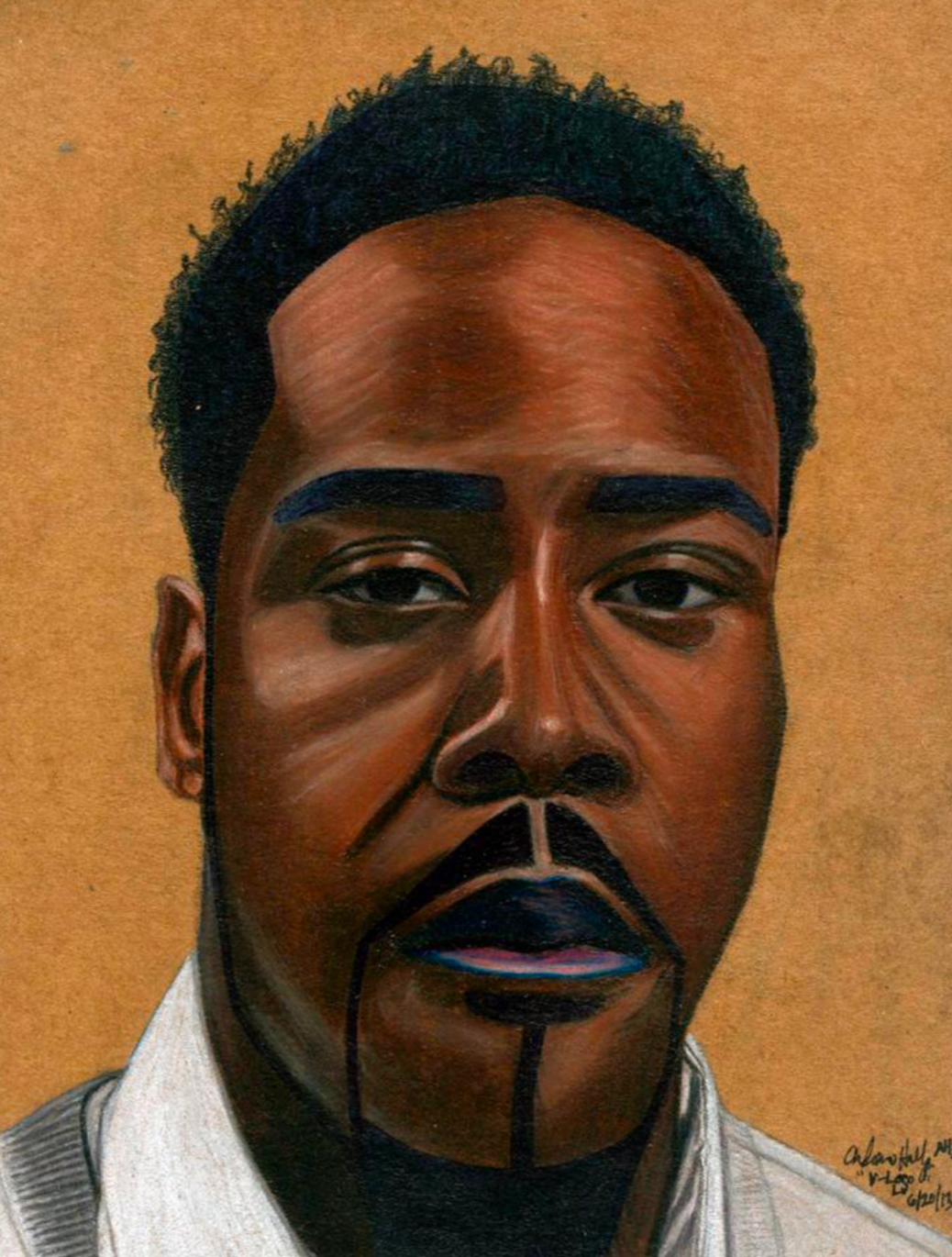
Self portrait
At Project Onward you are known as an amazing master of drawing. What do you like about the medium of drawing versus other art mediums you might have tried in the past?
I prefer traditional drawing because it comes more natural to me. I’ve done oil painting in the past. I like it because you can go over it, but it is very time consuming. I try to be efficient and work around deadlines. Also, painting materials are expensive, so then the price of my art has to go up. I have to think about who or how many people can afford to pay that much for art on a consistent basis.
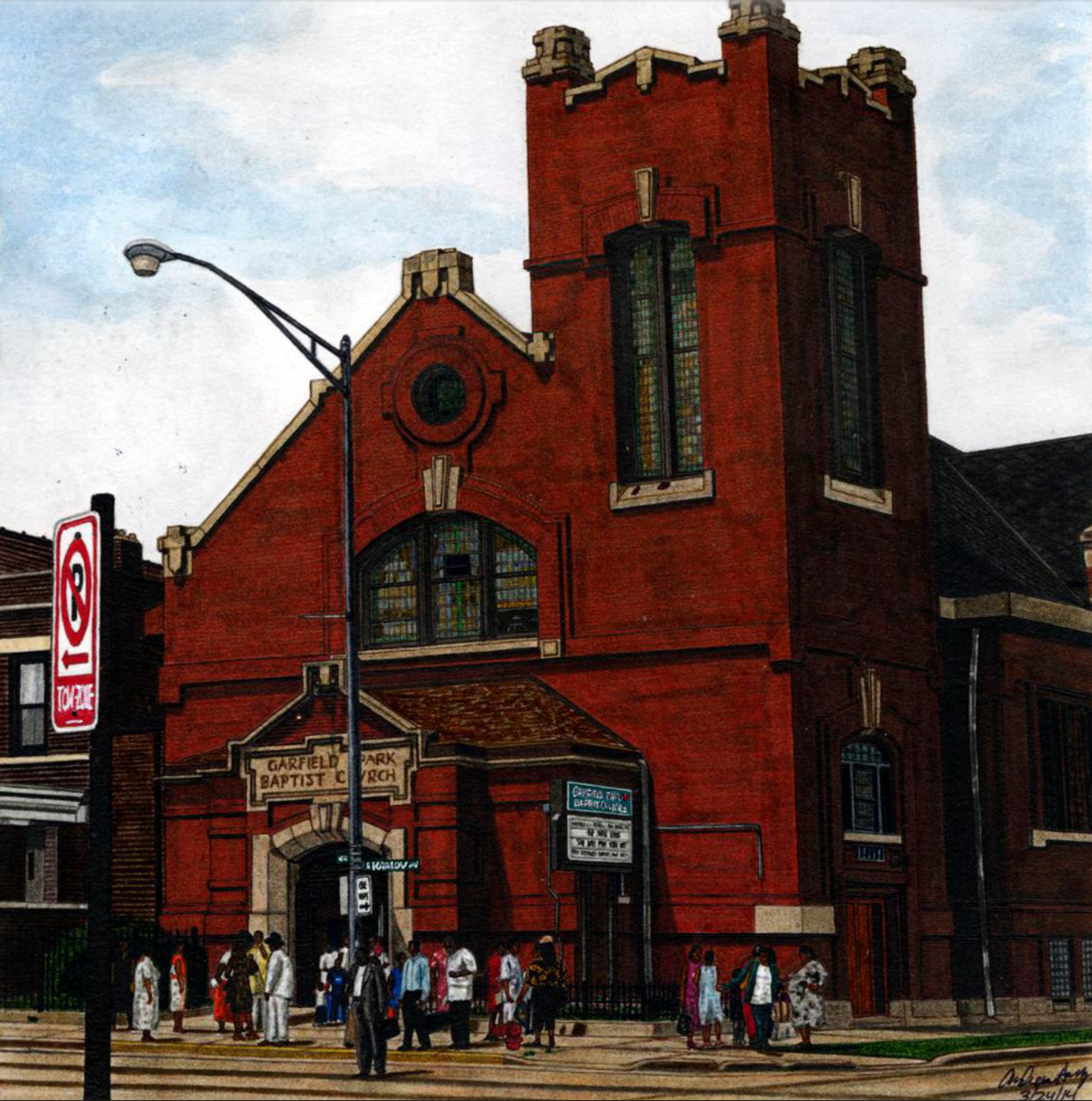
Garfield Park Baptist Church
The pieces you create are detailed beyond belief. What allows you to work so carefully to produce such intricate work? Do you ever get frustrated?
I think it is about time, consistency, and patience. I have to be able to calculate the amount of work that I put into a drawing. I’ve mastered different techniques with certain materials. Yes, when I have personal issues in my life and I am trying to get a certain technique down on a piece I am working on it can get frustrating. Also it’s hard when you work over and over on something and it doesn’t look how you want it to. So, if that keeps happening I will take a break, and come back to it the next day. That is why I have a number of different works in progress at the same time.
On average, how long does it take you to complete a piece?
It all depends on the subject matter and the materials I will be using.
Do you have a particular place or setting you like to work when drawing?
Sometimes a quiet place is good such as home or the library, but sometimes it is good to get feedback from other people such as in the studio or in a café.
Architecture and trains are of interest to you and clearly impact your work as an artist. What is it about architecture that inspires you? Are there particular types of buildings that speak to you more than others? Additionally, how did your interest in trains emerge?
The way the buildings are made is important, the structural engineering. I try not to limit myself to one type of architectural style. It is about whatever interests me at the moment. My interest in trains began almost instantaneously as a young child. I used to stay on the Westside, around Lake and Cicero Ave. I was surrounded by trains such as the RTA that turned into the Metra in 1984, and the CTA (L-train) Greenline. It was right above my house, when I was a little boy I would just have to look up and listen. I really got interested because of the locomotives. They have so much power and I love the sound they make. They captivated me from the beginning. The sound coming from the locomotive is my kind of music.
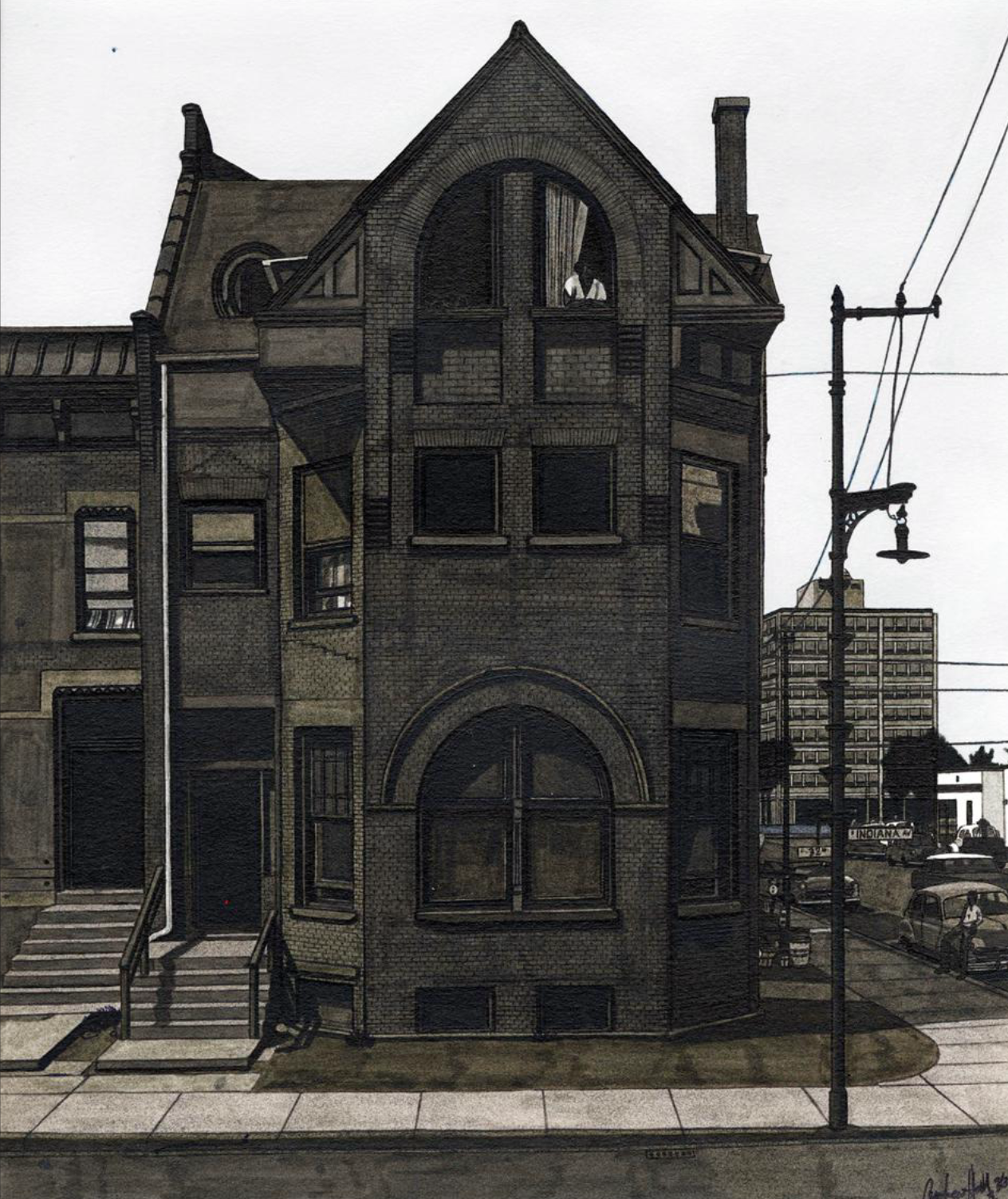
32nd Street & Indiana
It’s my understanding that portraits are a new genre you are exploring as an artist. Can you describe the process of drawing buildings and trains versus drawing people?
The thing they have in common is that I sketch them in with a pencil first, but the difference with portraits is that you can keep sketching and building up a very organic pliable form where as drawing trains and buildings you need to plan and lay out the forms with mathematical precision and proportions.
How did you get involved with Project Onward? What are your future goals as an artist?
I got involved through Gallery 37 in 2004. Gallery 37 was a high school training program in downtown Chicago that allowed me to make artwork. My goals as an artist are to set an example for other artists, and to make art my career. I’m currently working on a huge CTA project for the 47th St. Station. I’m drawing historical places in that area of Chicago and historically prominent African-Americans throughout Chicago’s history. My goal is to finish it in time and I hope that people will enjoy the work when it is completed.
Anything more you’d like to share about you as an artist and/or your work?
I feel that my process of art making is quite symphonic, building careful technique upon form and structure.
Find out more about Andrew Hall and Project Onward: www.projectonward.org