
Gene Sculatti’s Continuous Cityscapes
By Eva Rogers
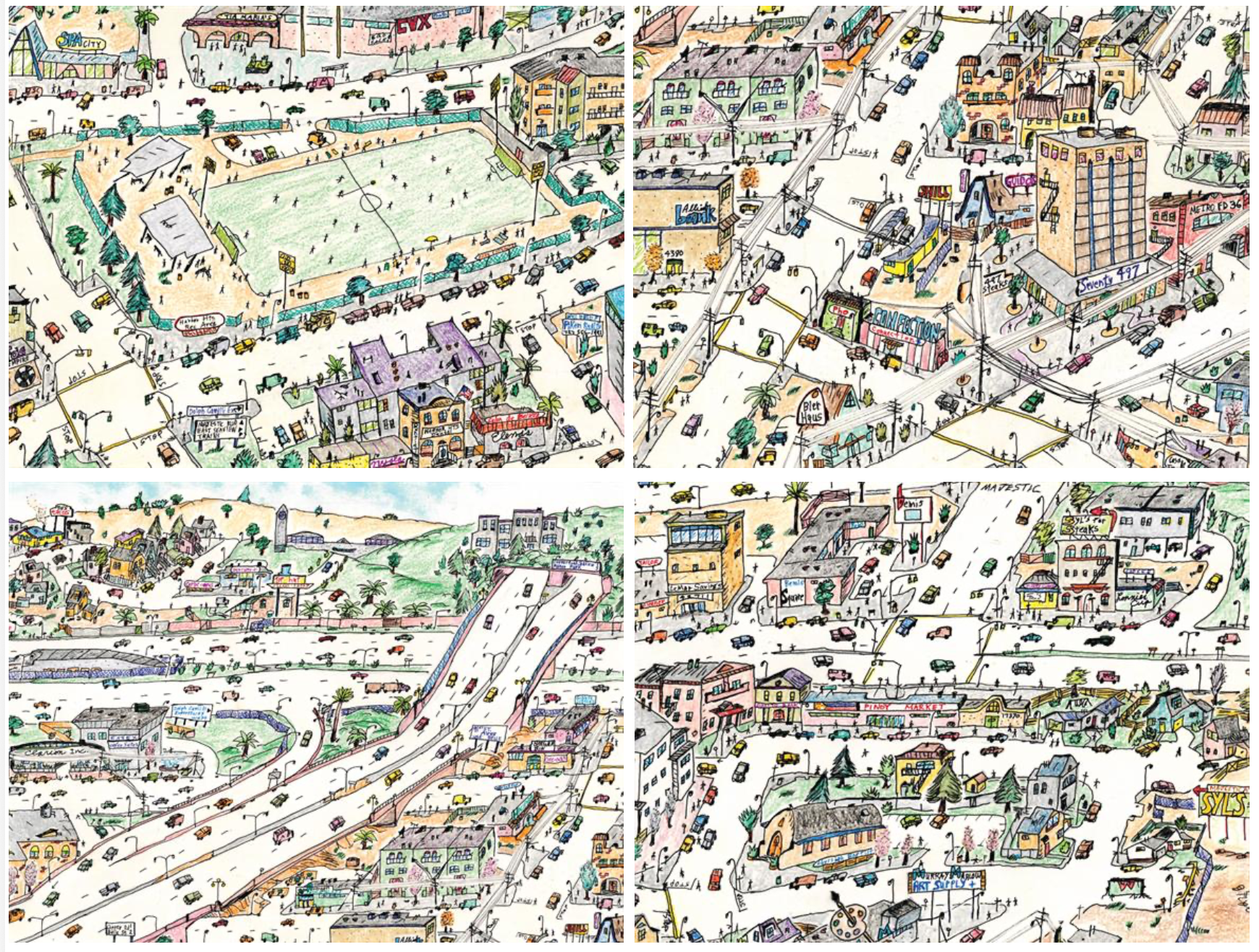
Details from the Cityscape scrolls
Gene Sculatti is an artist, music journalist, editor, and radio show host. Originally hailing from San Francisco, he later moved to Los Angeles to get into the music business. Gene has written for Rolling Stone, Creem, Radio & Records, and Crawdaddy! — the latter publication where he became the first journalist to write about the nascent San Francisco music scene in 1966. He is a former Editorial Director for Warner Bros. Records and Director of Special Issues for Billboard Magazine.
Imagine one of the world’s great cities; what do you see in your mind’s eye? People clustered or streaming along busy sidewalks, cars rounding every corner or parked end-to-end in traffic; apartments and street level shops giving way to towering office buildings; billboards and trees competing for space in the sky.
In 1956, Gene was nine years old and in the fourth grade when he began imagining and drawing his unique cityscapes. His first drawing was an 8x10 sketch of a city. Enticed by the potential of this first creation, he sketched another cityscape on a two-foot length of paper. But these straightforward dimensions could not contain him or the effervescent energy of the cities he sought to portray. Taping together discarded surveying charts from his father’s work at the telephone company, in 1958 he completed his first cityscape scroll drawing, 17 inches high and unfurling across 17 feet.
Give the scroll of time a swift snap and skip ahead to today, where Gene has continued creating his scrolls over a span of sixty-five years, and a cumulative 914 feet in length.
I was excited to talk to Gene about how and why he creates these drawings, which sparked for me the delight of the Where’s Waldo? books that captivated my youth: first, find Waldo in his candy-cane striped hat and jumper, then spend ages poring over the drawings, examining the near-infinite details of people wandering through densely packed airports, sunburnt and lounging on the beach, navigating amusement parks and pirate ships, finding love, losing essential garments, having their lunches stolen by errant dogs. As we talked, Gene shared with me some of the books, magazines, and illustrations that influenced him as a youth, the drawings that captured his attention and begged to be attempted in his own hand, from his own perspective.
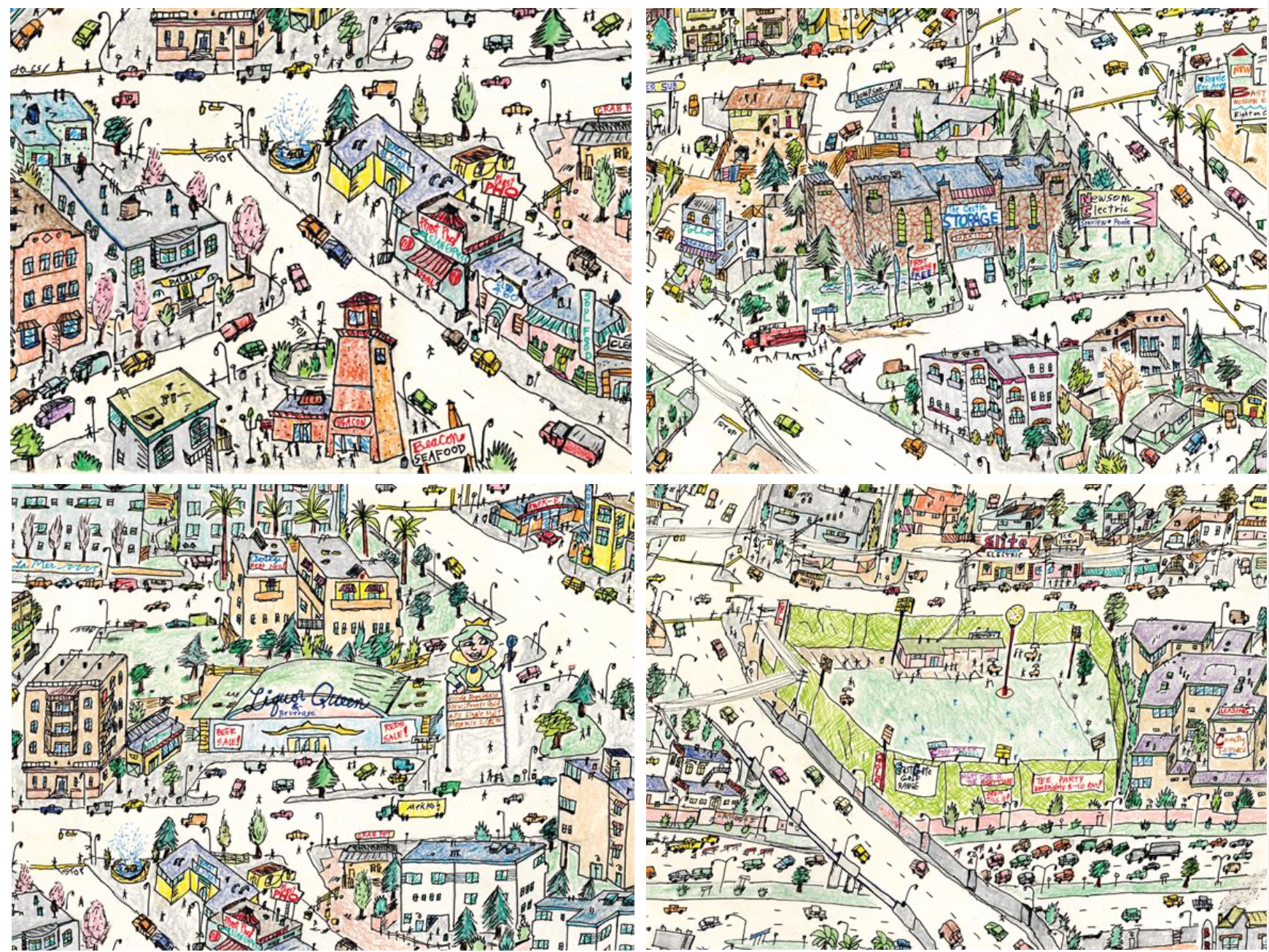
Details from the Cityscape scrolls
The first part of my interview with Gene involved the two of us sitting in the bright sun outside Gene’s home in Northridge, California, the rumble of occasional airplane traffic slicing through our conversation. The second part was Gene and I unfurling one of his scrolls — a piece called Majestic Boulevard, begun in 2006 and completed in 2011, measuring 84 feet in length — the sound of paper rustling, each of us cantilevered over the drawings, finding and pointing out spots that caught our attention, talking about where they came from. Donut shops recur in these drawings with a reassuring regularity; a visitor to Gene’s ‘scapes will not be left without a fried and sugared treat in hand as they traverse the city streets.
During our conversation, we unfurled a whole scroll from end to beginning, winding back in time. The physicality of the drawings was its own presence; as Gene unrolled his scroll I would periodically step to the opposite end of the long table where we were stationed, to make sure the scroll was doubling and tripling over itself in a way that didn’t pinch or fold the paper.
Gene’s scrolls have evolved from those early years in which he taped together pages of blueprint paper to achieve a continuous sheet; later, he used shelf lining paper, purchased in roll form.
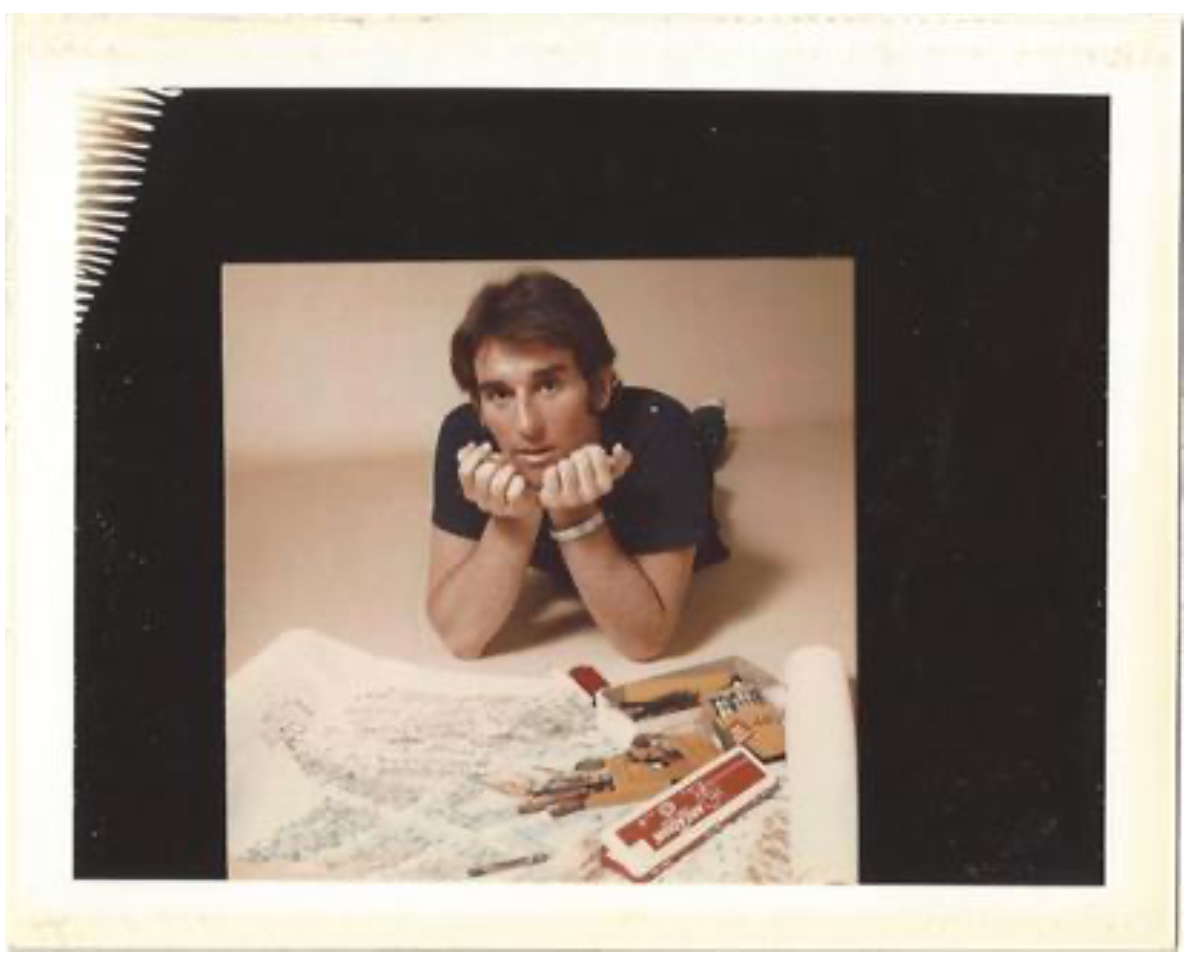
Image of Gene with a scroll and drawing supplies Photo taken by Dorothy Tanous
Mid-1970s
Gene Sculatti (GS): Only a few years ago, when I got the drawing table, I went to this art store in Laurel Canyon, and I got enough paper to last until the end of my life. And I use that. And I cut it in sections.
—
The word “scrolls” looped through our conversation, this form of a continuous work or text. Historically, the scroll was a precursor to bound books, delivering a document of length in advance of the concept of pages, of breaking artwork and imagery into production friendly scenes and spreads. Gene’s cityscapes are a continuous experience. As we talked I thought about how a street can unravel like a thread through a city; one of Gene’s cityscape scrolls is like a thread through both place and time; a scroll is a scroll, and a street can be a scroll, and a pencil line can be a scroll, and perhaps the donut shops are scrolls themselves, too.
I learned at the end of our conversation that Gene’s wife Marsha, now passed, had taken up this process of drawing with him, drawing city landscapes, her drawings containing her own sensibilities. Gene found Marsha’s drawings recently and has been bringing some of her ideas into his own drawings. Her stained-glass windows, her sense of perspective. She made these drawings in part as an activity she and Gene could enjoy doing together, and she was also good at it; I asked Gene if he knew Marsha could draw when they met and he said no, you never know those things right away. Perhaps they gravitated toward each other, these two people with a way of seeing and capturing the world in line and color, a sense for the steady unspooling of time.
—
Eva Rogers (ER): You’re a writer and editor as well as a visual artist; do writing and drawing exist in two different spaces for you? Is there anything about the way you write that intersects with the way you think about drawing?
GS: Well, I basically have three things that I do. Professionally, there is my writing and editing. I’ve also done an online radio show for a long time. With the writing, you’ve got to attend to the subject and it may be an assignment. But the music and the drawing — there are certain sensibilities. I think it’s the equation I make between the dynamism of a city, and representing it, and pop music and the energy that's in rock and roll, and things like that. Very often when I draw, I'll put something on in the background. There's something about the energy of it all that probably relates to the music stuff.
ER: Are the drawings subtly different if you're listening to something?
GS: That’s a good question. I’ll bet they are. Because sometimes I might put on something that's kind of background lounge music. Sometimes I might put on doo wop or rock and roll or something. It's possible. But it doesn't mean that if you put on Dion and the Belmonts, then you're going to be drawing stoops in Brooklyn. It's not that literal.
The Drawing Process
ER: When you work on your drawings now, do you work on them every day? What’s your rhythm like?
GS: As the weather gets warmer I do less. I might go through summer and not do any. I prefer it to be sort of stay-inside weather. You also gotta get inspired. I've got a new kick lately. What I'm doing right now is the street of San Fernando Road. It starts way up here. And it goes way, way down to downtown. The radio show I do relocated their studios to the Lincoln Heights area east of downtown. I have to take a freeway and then I take San Fernando Road down there. And it's this marvelous street; you take it from Glendale to downtown. And it just goes through all these changes. Like it starts out with heavy industrial, with trains and breweries. And then it meanders into Glendale, where there are a lot of Armenian auto shops. And then it goes through another part of Glendale where they've built all these gigantic loft high rises, residential places. Then it goes through more areas, it turns and it goes by the LA River. And then it goes to places where industrial buildings are being rehabbed into something else and it goes to these impoverished neighborhoods and winds up way down in industrial LA. And I just love the changes of it. So I invented a street — I had to look up some saints — called St. Marcellinus Road, to be San Fernando Road. And that's what I'm doing right now — trying to get the essence of San Fernando Road. It’s a really cool street. I haven't tired of just looking when I'm driving and seeing stuff.
ER: Do you ever repeat structures? Do you have favorite places or buildings where you say to yourself, “I’m going to bring that one back in”?
GS: There are some things that repeat through many of them. There are gas stations that are Shill instead of Shell — that came out of MAD Magazine — and Onion instead of Union. There’s a place called Pizza Wheel that is a chain. Do you know the Wiltern Theater down here, at Western? It was used for a movie called American Hot Wax about a rock and roll disc jockey in the ‘50s, Alan Freed — they made it look like a New York theater where they were having rock and roll shows. I’ve done that theater about four times, it’s a theater called the Palace, and it looks like the Wiltern, and there’s a marquee, and it shows different acts playing. People I’d like to see.
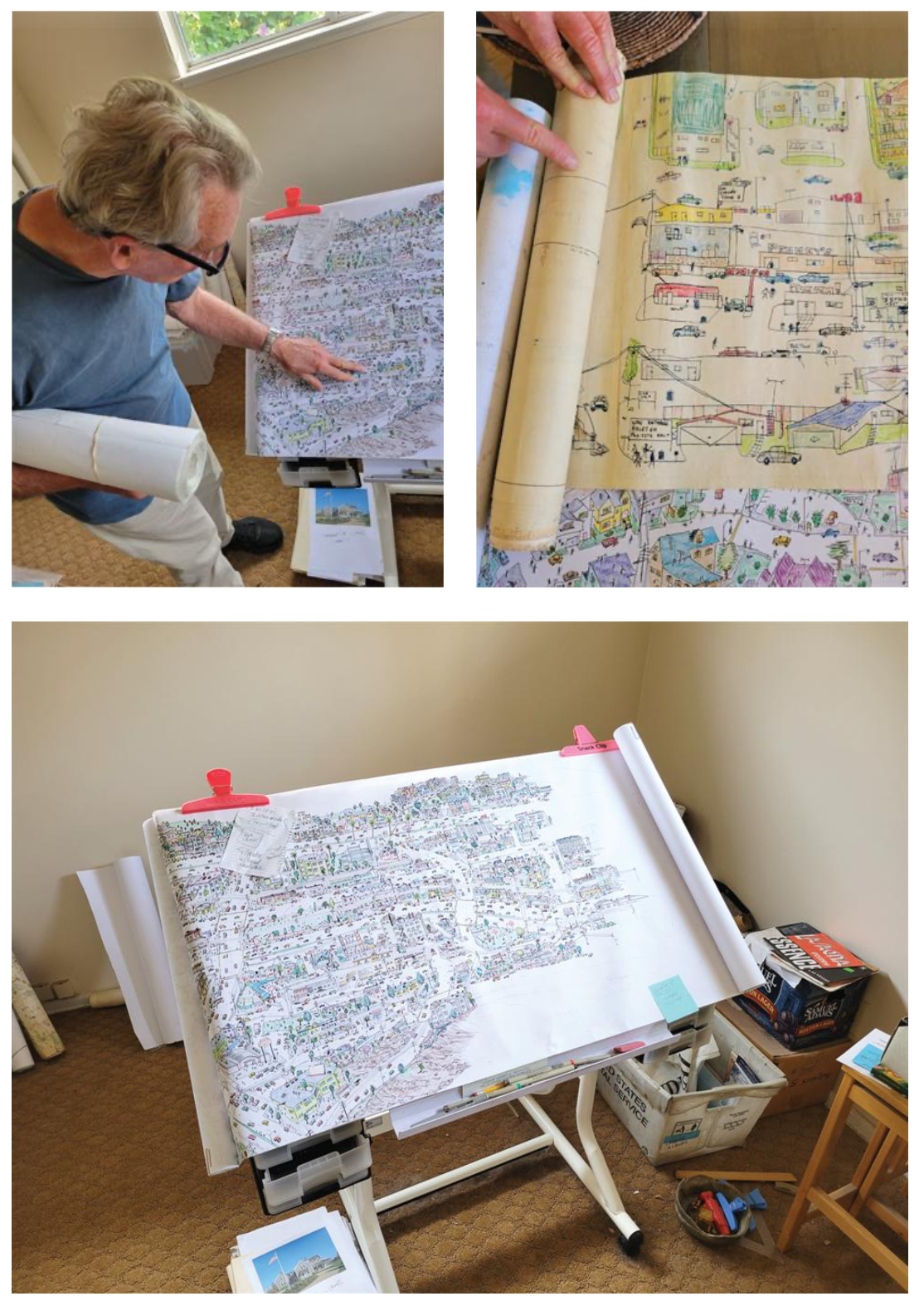
Top Left: Gene pointing out details on his current scroll project
Top Right: An older yellowing scroll on top of a more recent scroll
Bottom: Gene’s drafting table with his current work in progress
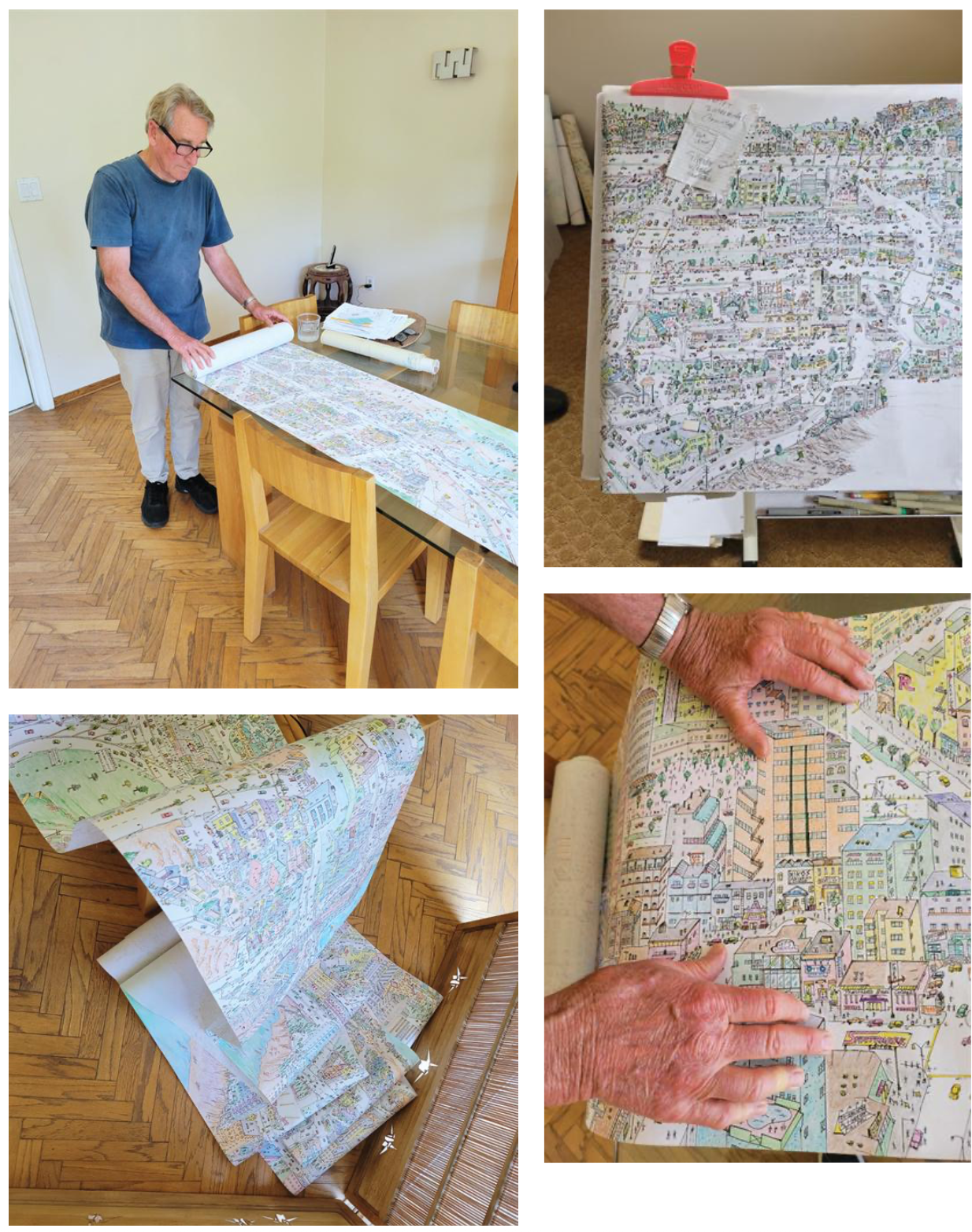
Top Left: Gene rolling out his Majestic Blvd scroll on his table
Top Right: Close up on his current work in progress
Bottom Left: A scroll unrolled and piling up on the floor
Bottom Right: Detail of Majestic Blvd with Gene’s hands
GS: There was a friend of mine, a great guy who passed away, named Bill. We used to call him Major Bill for whatever reason. And I made him a concert promoter. These acts together here — this is a rockabilly record. This is a doo-wop record. These are some mid ‘60s people. It would be a dream bill for me if I saw all those people on the bill, but they never will ever be.
ER: In the time that elapses as you work on a drawing, and as you’ve made these drawings over the years — have you ever drawn something that you then forgot you’d drawn? Does it ever happen where you look back at something you drew and it’s almost unfamiliar after you created it?
GS: Probably not unfamiliar. You just keep going. Now they're all rolled up. I'll show you one or two, and I'll say oh, yeah, I remember when I did that. There were embarrassing spots. You know the bay windows in San Francisco apartments, the windows that protrude. I like those, I like to draw San Francisco stuff. And I went online and got a picture of some Frisco apartment that had one of those windows, and I printed it out and set it there while I was drawing. And I did it, and I put it in above the top half. So it's in the middle, closer to the top. And it's really bad. And I can't do anything about it. Because the picture itself is taken — the photograph is taken kind of from below. So you'll see the bottom of the thing, which you know, kind of wide with the window within these protruding bay things. As if you're looking up at it. And at that part of the cityscape — you can't be looking up at it. You'd only be looking up at that if you were down at the bottom. Yeah, so it either has to be like straight horizon stuff, or the roof, and it's kind of a sore thumb to me. It’s bad! There are other things, once or twice in the past, I drew something that just didn't work, and actually when I was young, I just cut the thing out. Put a piece of paper behind it and then drew over it.
GS: I was so obsessed — I have, from way back when I was a teenager doing them, I have lists of street names to use, you know, and descriptions of what they would be like. Like “let's call this Acosta Boulevard, and what should that be? Light industrial, probably.” I didn't necessarily follow them. But a lot of them become like signs on freeways in the ‘scape — it'll say, such-and-such Boulevard, two miles. So yeah, it's just sitting there on yellowed paper, most of it, but you can revisit it.
ER: I like that question — what is the spirit of any street, what does it evoke? What kind of place is Acosta Boulevard?
—
I was curious if a drawing ever ended, and how Gene knew it had ended. Can a drawing ever really end when there’s always a new branch of a city to draw, a new winding street to follow? A new donut shop to install (and taste-test) in a new neighborhood?
—
GS: In 2006 I left my last real full time job. And I said at the time, I'm going to start this masterwork called Majestic Boulevard. So there will never be anything but that — everything that I’ve done since then is an extension of that. There are now about seven of them. So where this one ends, there is another one with a different name dedicated to a different street, but it connects up. If you were to put them together they would be one long scroll.
ER: So every scroll is now a part of Majestic Boulevard?
GS: Yeah. There's a Majestic East, Majestic West, and Majestic East Extension. There's a town called Seagate. About six or seven, although the extensions are shorter than this master one.
ER: I find that if I draw, there's something about it that becomes self-conscious for me; I see what I’m drawing and feel like, “this doesn't look good. What am I doing here?”
GS: That's what you have to let go of to do stuff like I do. It's not that accurate. But you're inspired by what you see, enough to want to — not necessarily replicate it, but you're just inspired by it. It kind of looks neat to you.
ER: A little bit of a capture.
GS: Kind of, yeah. And as time goes on, a lot of my drawings are genuinely nostalgic because I know the times in which they were done. And there are things in there that are no longer around. Everything is contemporaneous when you do it. But, for instance, in some of my drawings there are video rental stores. There aren’t any anymore.
ER: Or they’re very few and far between.
GS: In the really early ones, when I was, say, 13, there were things that really occupied me at that time and age, things that are over-represented. There's this comic book line called Classics Illustrated. What they did was, they took classic books and rendered them as comic books. A friend of mine and I collected them. All I knew about them was that the company that published them was in New York, and it was called Gilberton Press. And so in at least two of my drawings there are these giant buildings called Gilberton Press, because I liked that. Another thing is, I'm Catholic, so maybe every three blocks there would be a Catholic church, among other churches. And the other thing that there was way too much of when I was a teenager is junior high and high schools. Every block has one of those because that was my interest then.
California
ER: Do you draw places other than LA?
GS: It’s all imagined, it’s all fictive. There are elements in there, even whole sections, that are like clip art. I took elements out of a luxe real estate ad from The New York Times Magazine with high rises in it. I’m doing cities. Although California to me is the pervasive place.
ER: If you weren't from California, do you think you would have done this kind of work, no matter what, by the nature of who you are? I’m curious how much it's informed by place.
GS: It’s pretty informed by place. I mean, a guy could do this in Indianapolis. In my case, though, we moved out of San Francisco when I was five or six, we moved back to Napa Valley, where my parents come from. So it was always like real Emerald City stuff. I grew up in a small town there. And of course we’d visit San Francisco. But there's always been something kind of magical about San Francisco — and also about LA. And I don't know if it has to do with growing up in a kind of rural area and wanting to be in that urban area. But geography has something to do with it.
GS: When I got really obsessed with Southern California, around the time of the Beach Boys, I really gravitated to parts of Northern California that look like suburban LA. We had relatives in Sacramento, and that was really like LA, and then there are parts of the peninsula — San Jose is really like LA. They're kind of parched areas with endless streets. I used to take photos, too, when I got a camera in the late ‘60s. I took a lot of photos of Sacramento, of signage or the way the suburbs crept into the foothills.
GS: At one time I visited my college roommate, his brother lived in Laurel Canyon, we came down here and visited him. I thought, Man, this is great. It's sort of like this big forest. But there are houses everywhere, too. And it's in the middle of the city. And I went back and I thought, Oh, I'm gonna draw something like this. And I immediately abandoned it because it meant drawing too many trees. I have areas called something Canyon on one of them. And there are hills and roads going up at a few houses. And there are a few trees and I just said, Oh man, I can’t keep drawing trees. It's more labor intensive than drawing cars. So I just couldn't do it.
Examining the Drawings
GS: Now this has some historicity to it. This is a ballpark which is based on San Francisco in the ‘50s, before the Giants moved there. There was a ballpark off the 101 freeway, kind of in Potrero Hill. They had a semi-pro team called the Seals, the San Francisco Seals. And Seal Stadium — that's what this is based on. So it was really sort of a personal thing. And then when they're going to build things next to Cardinal Park — they were the Cardinals in my fictitious world — it became Stadium Terraces. And this is a real sign that they had back east. If a guy hit a homerun and hit the sign, some clothier would give you a new suit.
ER: Give everybody a new suit?
GS: No, the guy who hit the home run.
ER: Ah, okay. Sometimes now there’s a thing where if someone hits a homerun everyone gets a taco — but it would be a lot to give everybody a suit!
ER: I like the Fluff ‘n’ Fold.
GS: It's pretty mundane stuff.
ER: I think there's something fun about capturing the mundane stuff. That is what life is made of. It's made out of the Fluff ‘n’ Fold and the West Palms Lease billboard.
ER: I'm trying to figure this one out — Unc and Wisty's?
GS: A friend of mine knew these people a long time ago who were grifters. There was a woman named Wisty and her uncle. They pulled minor scams. And my friend Dick would tell me about Unc and Wisty. Wisty, like Wisteria.
ER: Wow, that’s quite the name for a grifter.
ER: Oh, I like this little construction scene happening.
GS: I don't have too many ways to do that. So they all look the same. No matter how big the project, there's some steel framing and then a ladder and some wood.
ER: The scale at which you’re making these works, and the fact that people in them are little stick figures — I was curious if, when you draw the stick figures, are you thinking about them being people in place, or are you sprinkling them in casually?
GS: First of all, you’ve gotta have some people there. Secondly, if there’s a line at one of those theaters to get in to see the show — that has to be there. If there’s a store, there might be a bunch of people outside, and they’re so tiny. Somebody asked me once, how come the people aren’t bigger? Well, that’s what it is. In the earlier drawings I did when I was a teenager and more obsessed with fashion and the way people looked — there are close-ups of people in the foreground, like teenagers from 1963. They’re very big.
ER: It makes sense in the scale of the drawings that you’re making — if the people were bigger, you’d have to be zoomed in further on the whole concept. Do you ever picture yourself being any of the stick figures? Are you in there?
GS: I think I’m outside.
GS: I don’t know who this is ever for — it’s just an obsession that you do and you keep doing it.
ER: One thing I was thinking about, looking at your drawings — I don't know if it's quite nostalgic — but I think that your traffic always looks pleasantly semi sparse. Not that congested. When I think about LA I think about it being really densely trafficky. So it looks like more of a casual flow of traffic in your drawings.
GS: There are places though, where you know, there's a light and then there's stuff backed up. Or there's a crash.
ER: It would obviously be different if you were committing yourself to the concept of traffic, you'd have to be drawing cars all the time.
GS: I’ve thought about that — how many cars have I drawn? The same primitive, tiny car. More than people, probably.
ER: Thinking about scale — the people in your drawings are essentially stick figure-esque. But the amount of detail that goes into the cars and the buildings — the scale is different. It's interesting for people to be there, but people aren't really the focus of the work.
GS: Yeah, I think that's why — on the occasions when I'm able to show this stuff — people see all the cars and automatically assume it's Los Angeles or California. Car-centric. You’ve got to show that.
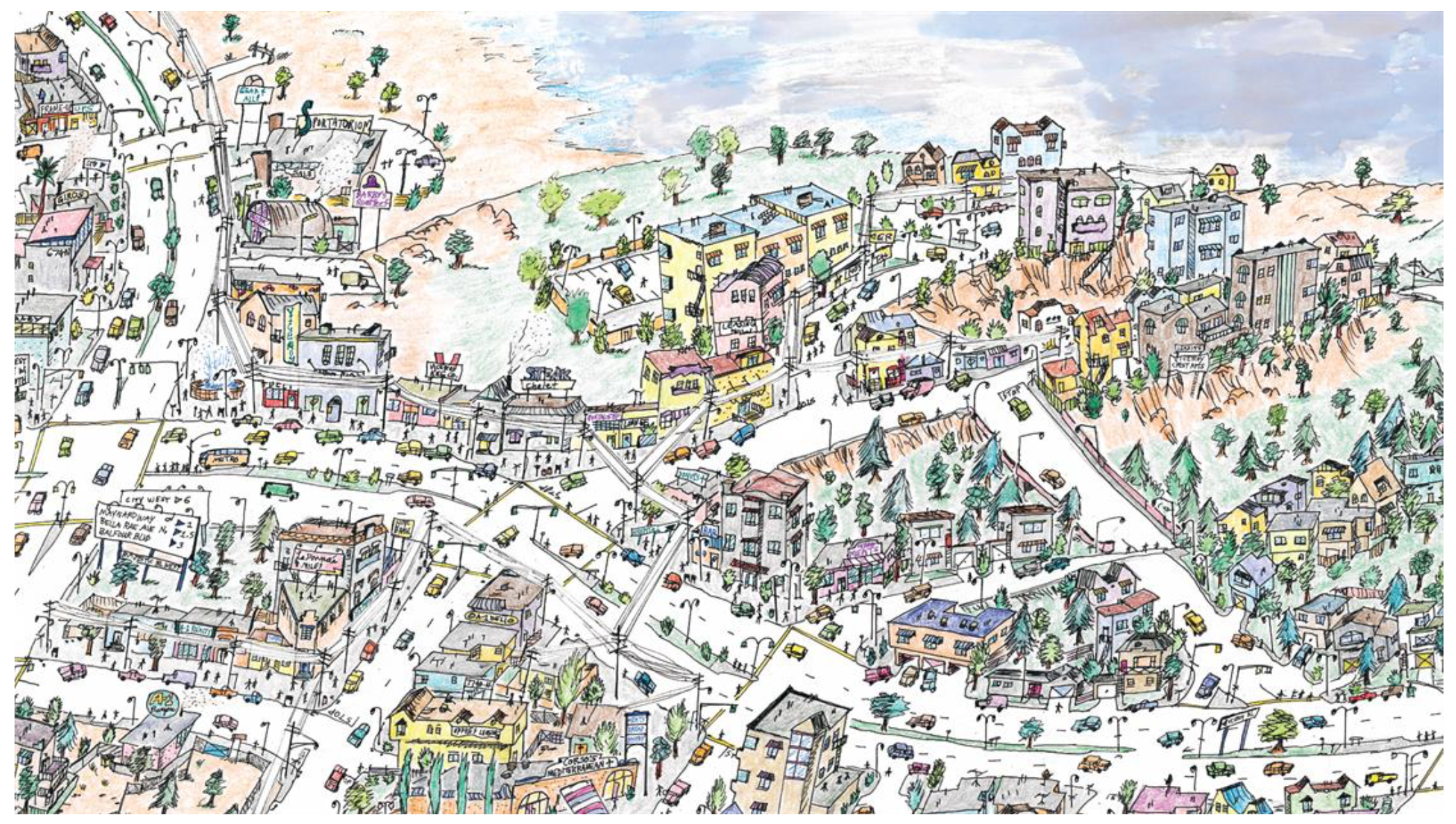
Details from the Cityscape scrolls
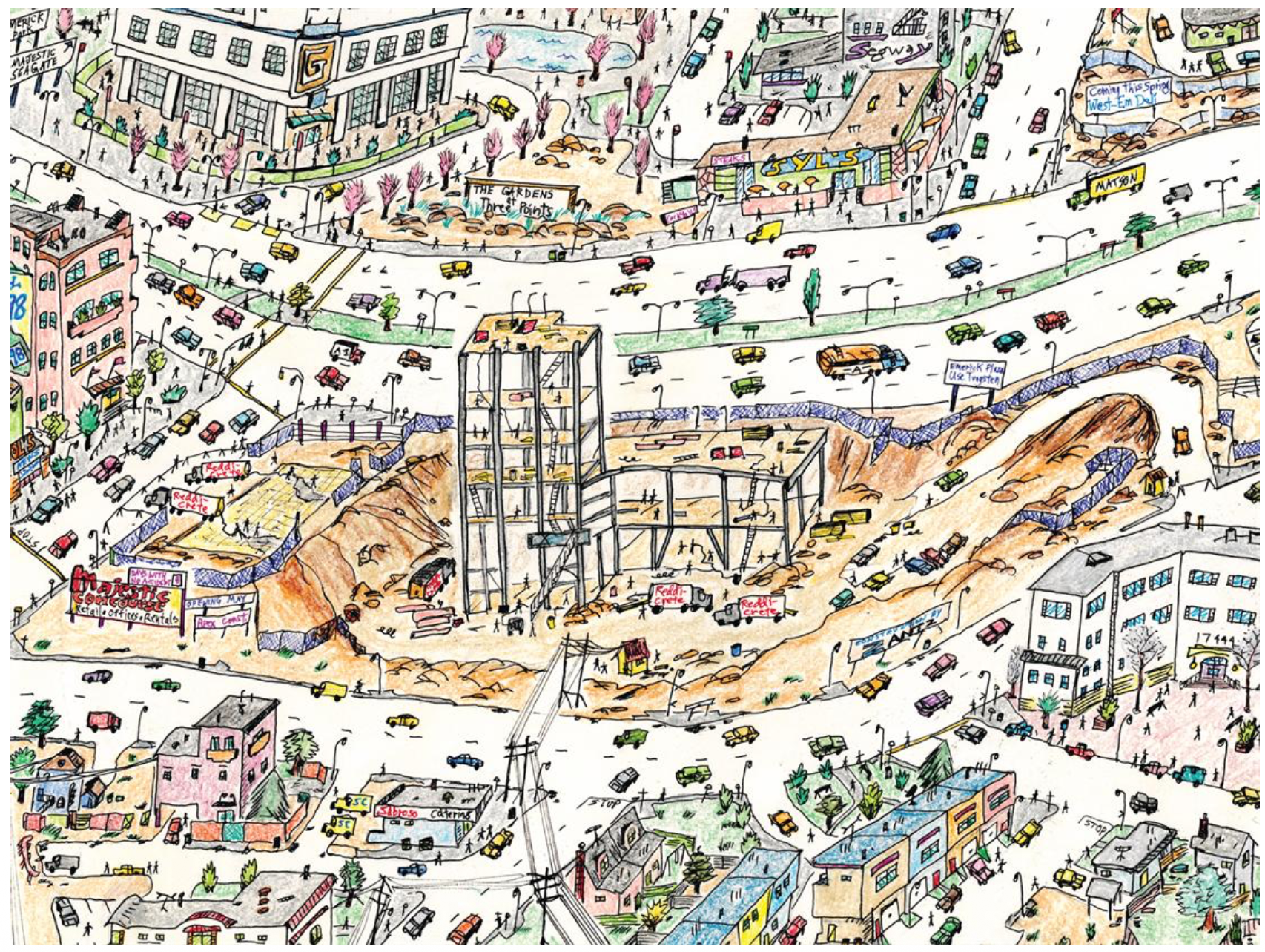
Details from the Cityscape scrolls
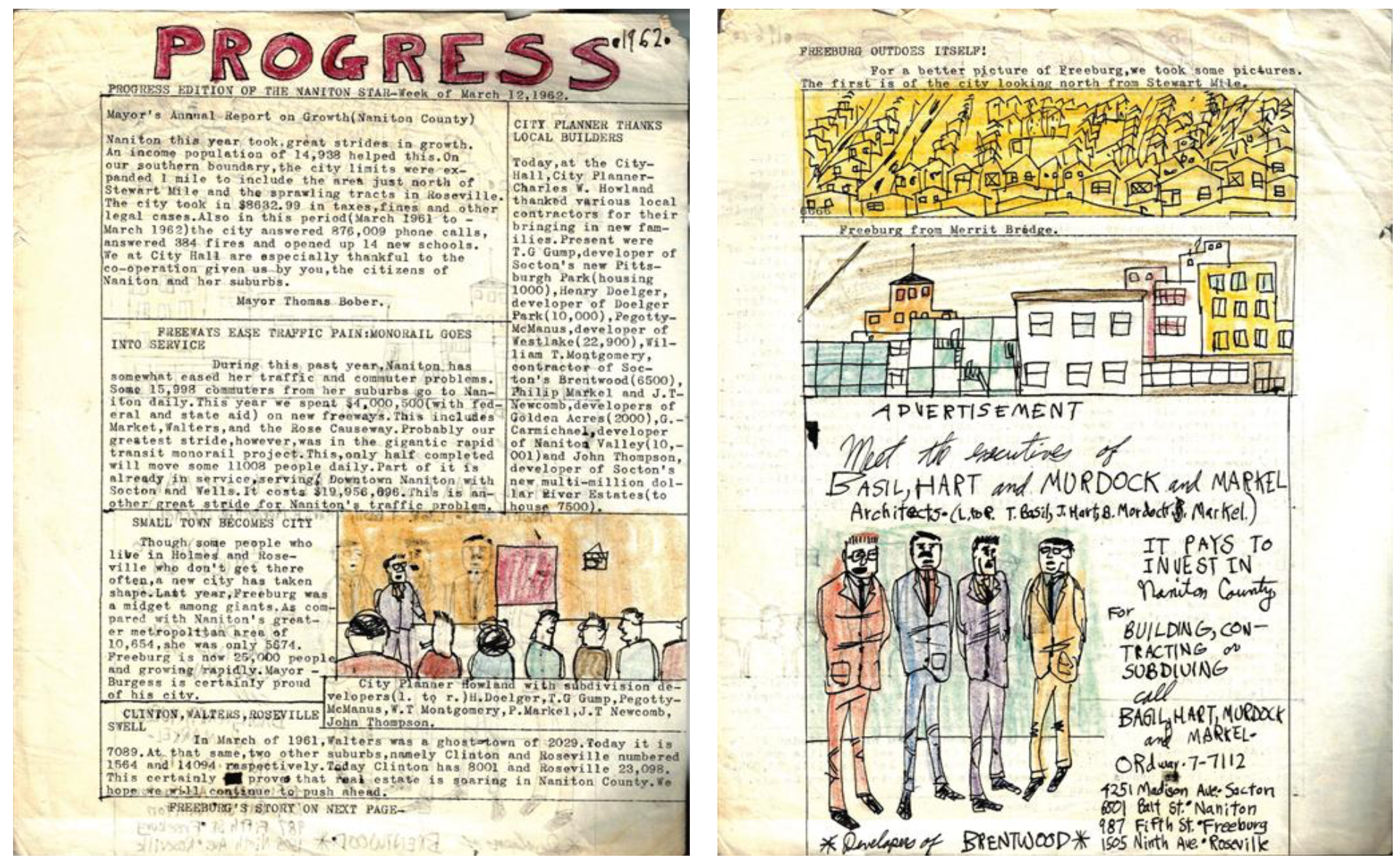
GS: In the early 60s, when Cali was culturally and economically bursting at the seams, local newspapers often published occasional special editions, touting how fast their region was growing. So I did my own, to accompany the Naniton 'scape and its various suburbs.
Note: Drawn over the course of 1960–62, The Naniton cityscape is Gene’s longest scroll, measuring 16 inches high by 192 feet in length.
List of Cityscape Scrolls
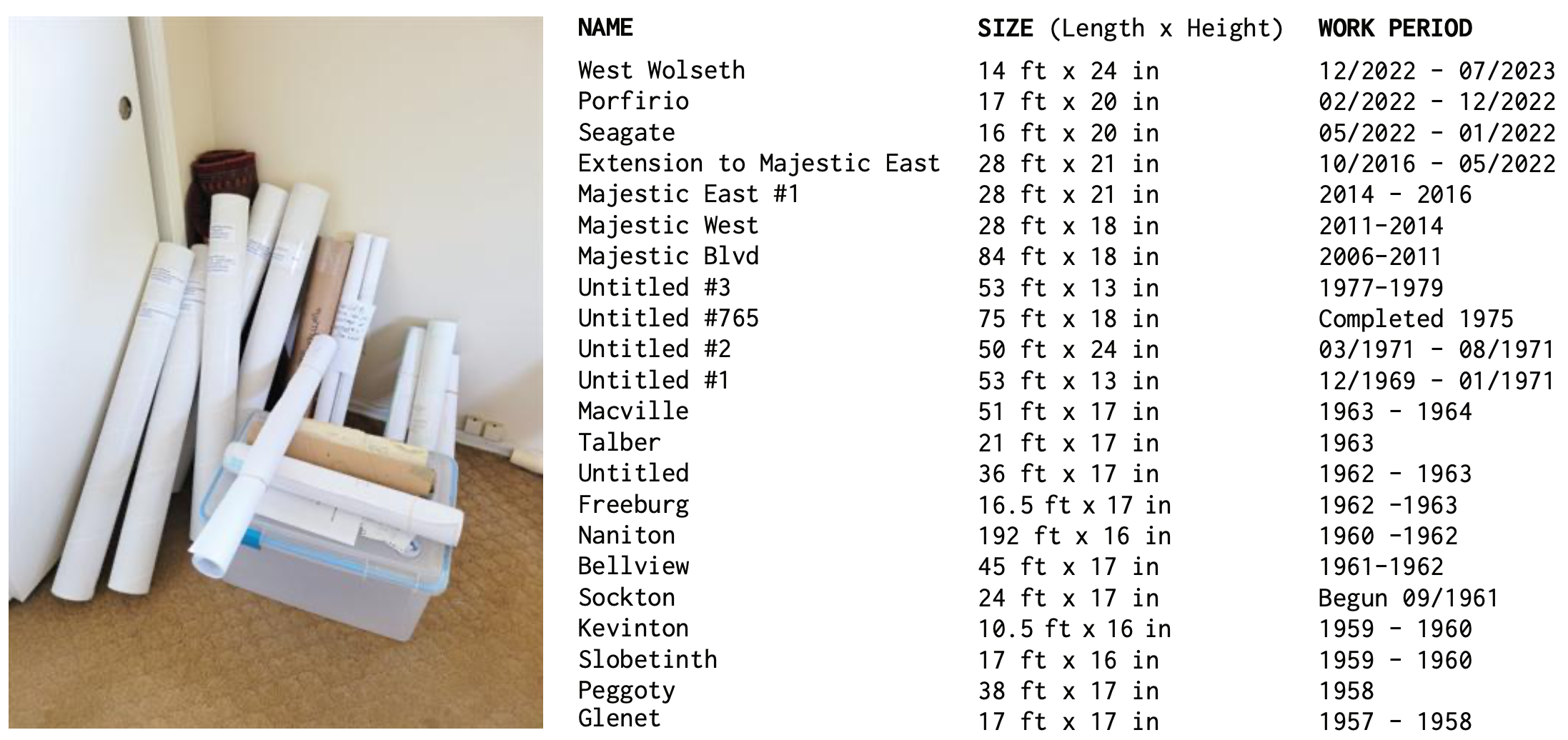
Collection of tubes storing scrolls
Appendix
I wanted to do the math on the total square footage of Gene’s drawings. He created a document to inventory his works and their dimensions, and I drew that inventory into a spreadsheet. I sent myself down a math rabbit hole to understand both the breadth of Gene’s work and the relative scale of the city, or cities, he’s covered over the years.
Across 22 drawings, he’s created a cumulative 914 feet in length. The drawings are of variable heights, ranging from 13 inches to 24 inches. By my math, his drawings total 190,230 square inches, or 1,321 square feet. Thinking about that quintessential measuring device, the American football field — 300 feet from goal to goal — Gene’s drawings could stretch across three football fields, with a bit trailing on into the end zones.
I considered how to figure out the scale of Gene’s drawings, thinking about the cities Gene has created relative to the scale of the human environment. I decided while talking with Gene that I would use one of his cars as the icon by which to determine a drawing’s scale relative to human scale. I estimated, from the drawings I saw, that one of Gene’s cars was approximately half an inch long. According to a cursory internet search, a midsize sedan is approximately 14 feet or 168 inches long. This means that the scale of one of Gene’s drawings is, in inches, 1:336. This means that 914 feet of drawings would approximate the equivalent of 307,104 linear feet of human proportioned cityscape, or just over the equivalent of 58 miles.
What are the dimensions of LA proper; how much ground has Gene covered across these years? According to Wikipedia, the city of Los Angeles extends for 44 miles from north to south and for 29 miles from east to west; drop into a drawing to traverse the totality of Gene’s cityscapes and you’d travel equivalently further than a north-to-south journey across the whole of LA.
—
Follow Gene and his Cityscapes:
Instagram: @sculatticityscapes
Facebook: www.facebook.com/sculatticityscapes
Gene’s weekly radio show is Atomic Cocktail, which is reachable at luxuriamusic.com
Also check out his self-published memoir: For the Records: Close Encounters with Pop Music. Available to order through Amazon
Do you want to see or exhibit Gene’s scrolls? Contact him at: eugenesculatti@gmail.com
-
Eva Rogers is a writer, editor, designer, fundraiser, and multifaceted storyteller.
Find her @rogevarog // evarogers.com