NIAD
A conversation with Julio Rodriguez
By Monica Fernandez Zuñiga
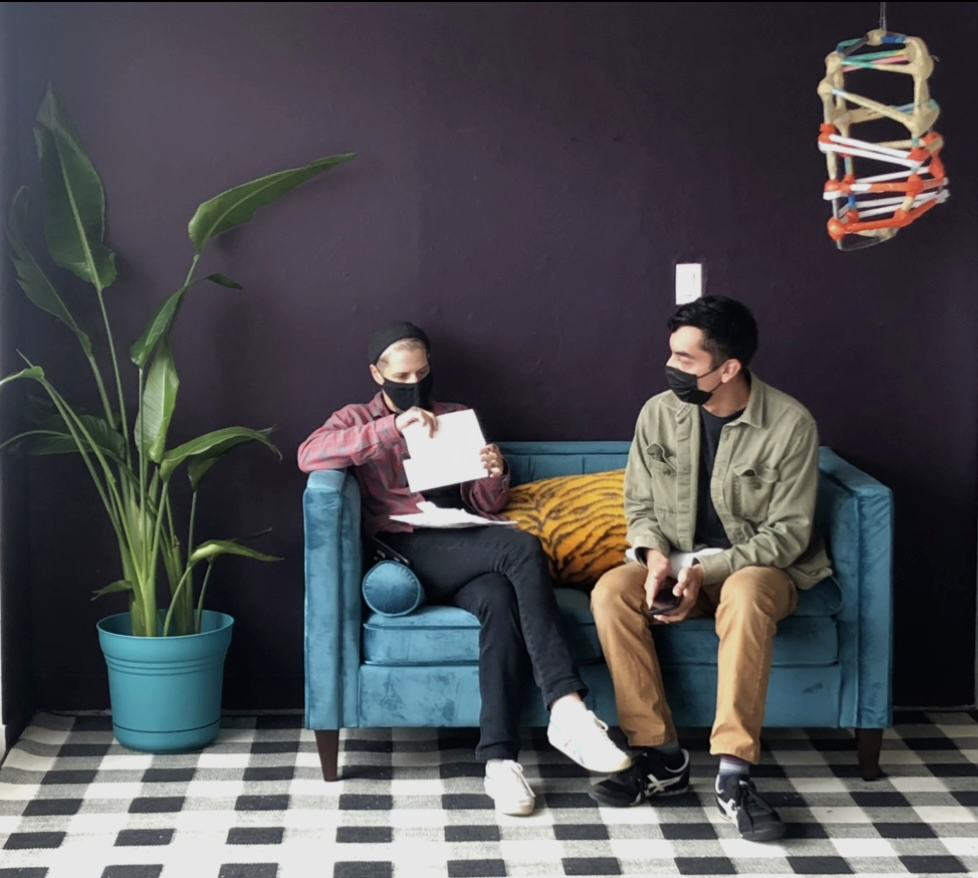
Gallery Manager, Julio Rodriguez (right) meeting with Community Programs Director, Ember Avalos (left)
It's a rare day when you come across an organization whose mission includes humor, fun, and joy as core values. A place where unorthodox ideas and imaginative perspectives are nestled, nurtured, and set out to be all they can be. When you come across such a place, consider it an invitation to mull over what you see and feel, if for no other reason than to see yourself within it. Such a place welcomes people as their full, authentic selves. It’s a place where creativity, experimentation, trust, and dignity are central to life – leading people to self-discovery, freedom … and without a doubt, some fun. Nurturing Independence Through Artistic Development (NIAD) is THE place.
NIAD is one of the oldest progressive art studios for people with disabilities in the country. Since the 80s, they’ve been redefining what Contemporary Art is by placing the same value on the work of artists with disabilities as any other artist tearing up the art world. They do this by offering nurturing art studios and a dynamic exhibition program where art merges with life, challenges social norms, and reshapes it.
It's a simple premise really, yet one that remains rare - even in 2022 when one may have thought we’d be more evolved versions of our 1980s selves. NIAD is one of several increasingly present art studios asserting their place at the proverbial art table. Before artwork is hung on the walls, artists experiment, resolve, challenge, fail and try again. Artists working at NIAD are no different, yet there is something unique about experiencing the work coming out of its studios. It could be joy, fun, and humor manifesting itself sure, but the work asks questions I've erased from my thinking, ignored, or even suppressed.

NIAD Art Gallery in Richmond, CA. Artist Miguel Chacon (center) presents during his artist talk for the opening of his solo exhibition OBSERVER, May 2022.
NIAD isn’t just a place where artists work. It’s a place led by visionary people for visionary people. Together, they come together to push beyond ideas of fitting in by redefining how we value ideas, beliefs, and even creative expression. From that place, they create an environment where people take flight, yes through art but also by inviting others to connect to what is really important in life (hint, it’s the small things). In my book, that’s rare and it comes with a whole lot of vulnerability, empathy, and looking in the mirror. So, it may stand to reason that the artists at NIAD are just the right group of people to poke at us viewers to do some reconsidering of our own adventures, secrets, and beginnings. And when we do, how can we not ponder listening (rather than talking) or dreaming (rather than stagnating)?
Art school may have taught me how to pull a print from a chunk of limestone or how to express an idea with a drawing, but it did not encourage me to be all the parts of myself. I can only dream of how life would be different if my art school experience was doused in NIAD’s approach. Instead of me taking you down my memory lane, let’s take a look at the work of Miguel Chacon, a self-proclaimed observer who I got to know through my interview with NIAD’s Gallery Manager, Julio Rodriguez. We're talking Freddie Mercury, soul searching, and what it really means to be inclusive.
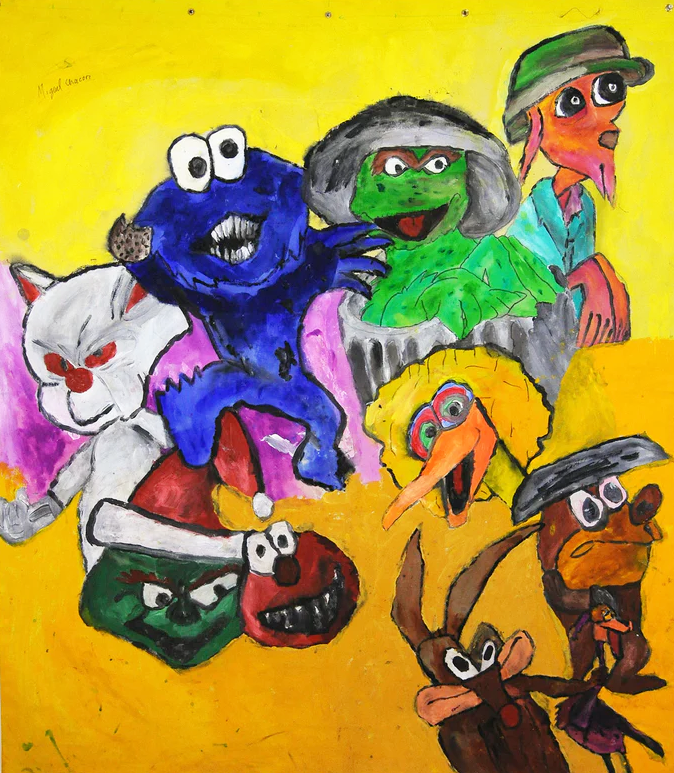
Miguel Chacon, Thinking of Sesame Street acrylic and marker on unstretched canvas 50.5 x 57.5 in, 2022
MFZ: What is the premise of Miguel Chacon’s solo exhibition, OBSERVER? How did it come to be?
JR: Miguel Chacon's solo exhibition OBSERVER began with a painting. After participating in SFMOMA's Mini Mural Festival in the summer of 2021, Miguel returned to the studio and directed his energy towards larger acrylic paintings. One of these (Thinking of Sesame Street) really piqued my curiosity. After hearing his explanation of the piece and about how he was using familiar cartoon characters to convey some of the experiences of having grown up in Richmond CA, we decided a solo exhibition was needed.
MFZ: Miguel mentions his preference for listening over talking. How does this play out in his work?
JR: Miguel's paintings have reflected his experiences as a listener. He depicts scenes based on his observations of the world through personal experience and media channels. These can range from portraits of pop culture icons to symbols of rebirth and the nature of reality. Miguel uses his paintings as spaces within which to unload his statements.
MFZ: What's the connection between Miguel and Freddie Mercury?
JR: Besides being a fan of his music, Freddie Mercury was unapologetically himself. Miguel believes this to be an important part of being a maker, especially when in the public eye. He also believes in representation of all people in the media.
MFZ: How is humor infused in the work you do at NIAD?
JR: I think being able to have a good sense of humor lends to flexibility, which has felt important in the uncertainty of the pandemic. I often look to the comic-style illustrations of Nathan Lam for balance. I appreciate his way of turning a mirror to some of the absurdities of being a person.
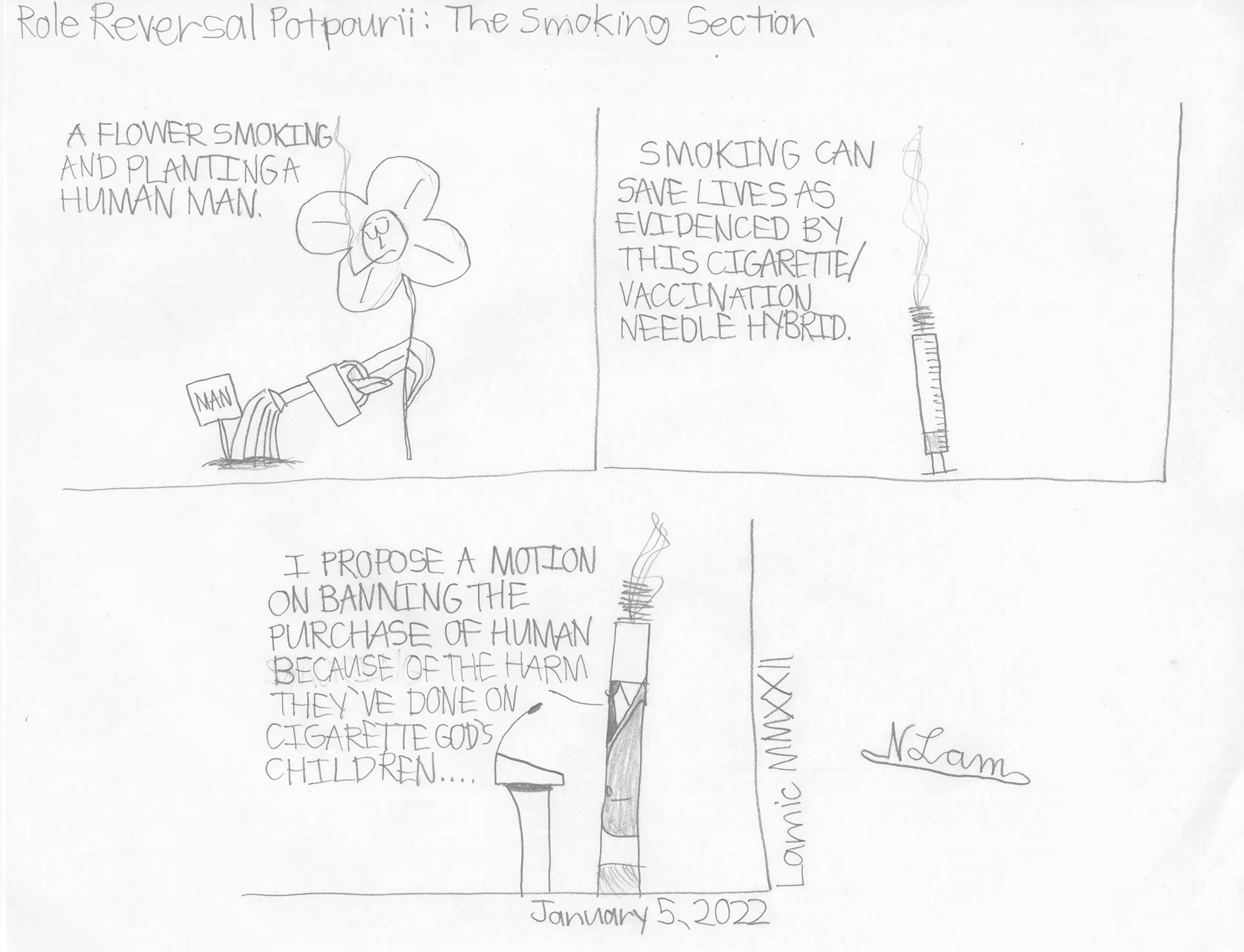
Nathan Lam, Role Reversal Potpourii: The Smoking Section, graphite on paper, 11 x 8.5 in, 2022
MFZ: Increasingly more and more people have a connection to inclusion. Can you tell us what it means to you in your work at NIAD?
JR: Well in a literal sense it means working closer with NIAD artists in creating our monthly exhibitions. Including artists in generating show titles and statements, curatorial projects, and our cataloging process. It also means working to increase the presence of our artists in art communities near and far. I work to facilitate exhibitions and projects that center artist voices and present the work primarily within the context of contemporary art.
MFZ: What are some inclusive practices you consider as key in supporting artists at NIAD?
JR: Listening and holding space for each person comes first. Supporting the individual artist where they are, staying committed to the integrity of the creative process, and not rushing through details are all important.
MFZ: Miguel really makes a case for listening and observing as a way to feed your soul. It's a big message that leads me to wonder how artists like Miguel impact our lives in quiet, perhaps unexpected ways. In other words, what's your favorite aspect of working with NIAD artists, and how has the experience impacted your personal life?
JR: I am constantly reminded of what I think is the most important part of making, that you enjoy what you do. We all connect to work or make work at NIAD because of an appreciation for art. Being around so many individuals that are dedicated to their practice, that never gets old.
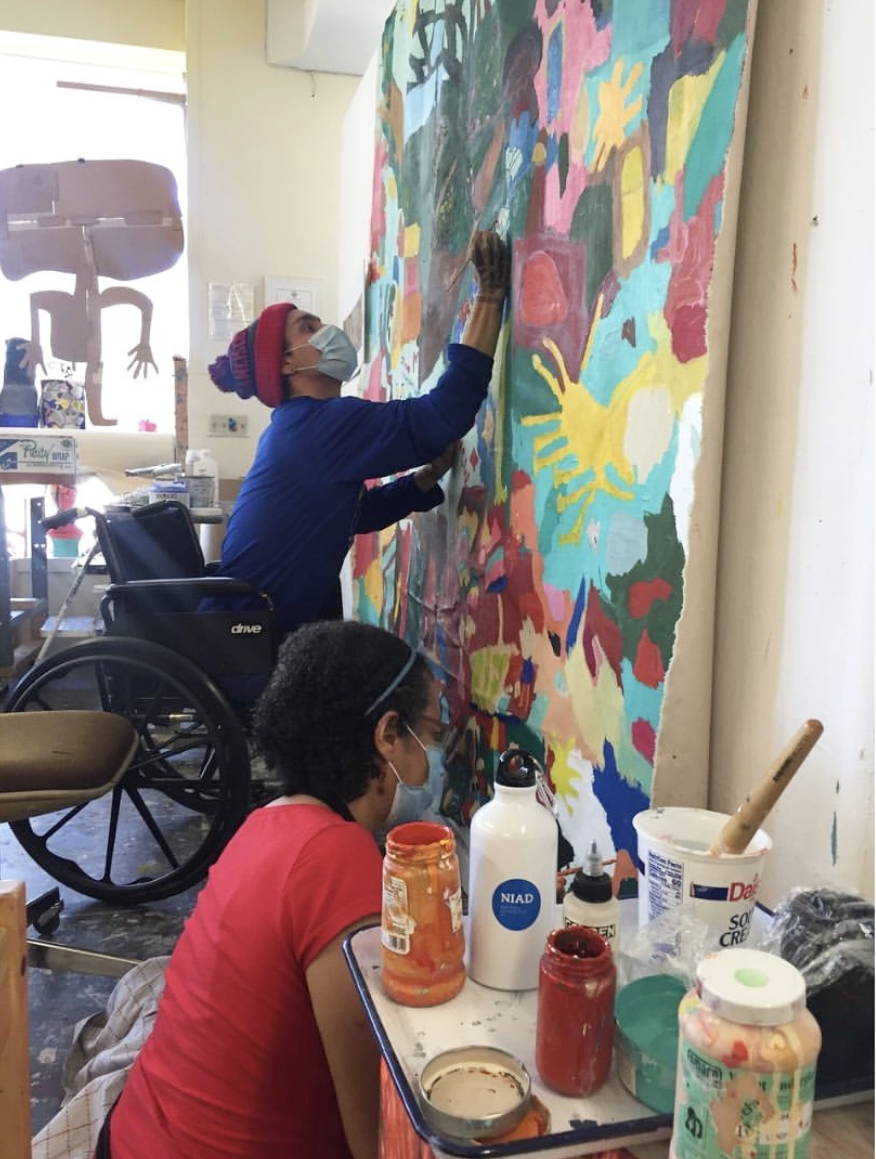
Miguel and artist Deatra Colbert in the NIAD Studio working on a canvas used for the SFMOMA mini mural festival
MFZ: Inquiring minds want to know: there are many remnants of the 80s that come through there. Michael Jackson, KISS, Tupac, and Jack La Lane are just a few, what's in the air at NIAD?
JR: Well, we are lucky to have artists in our studio who have made artwork at NIAD from the 80s to now. They are able to recall the history of the studio and definitely keep 80s culture present to this day.
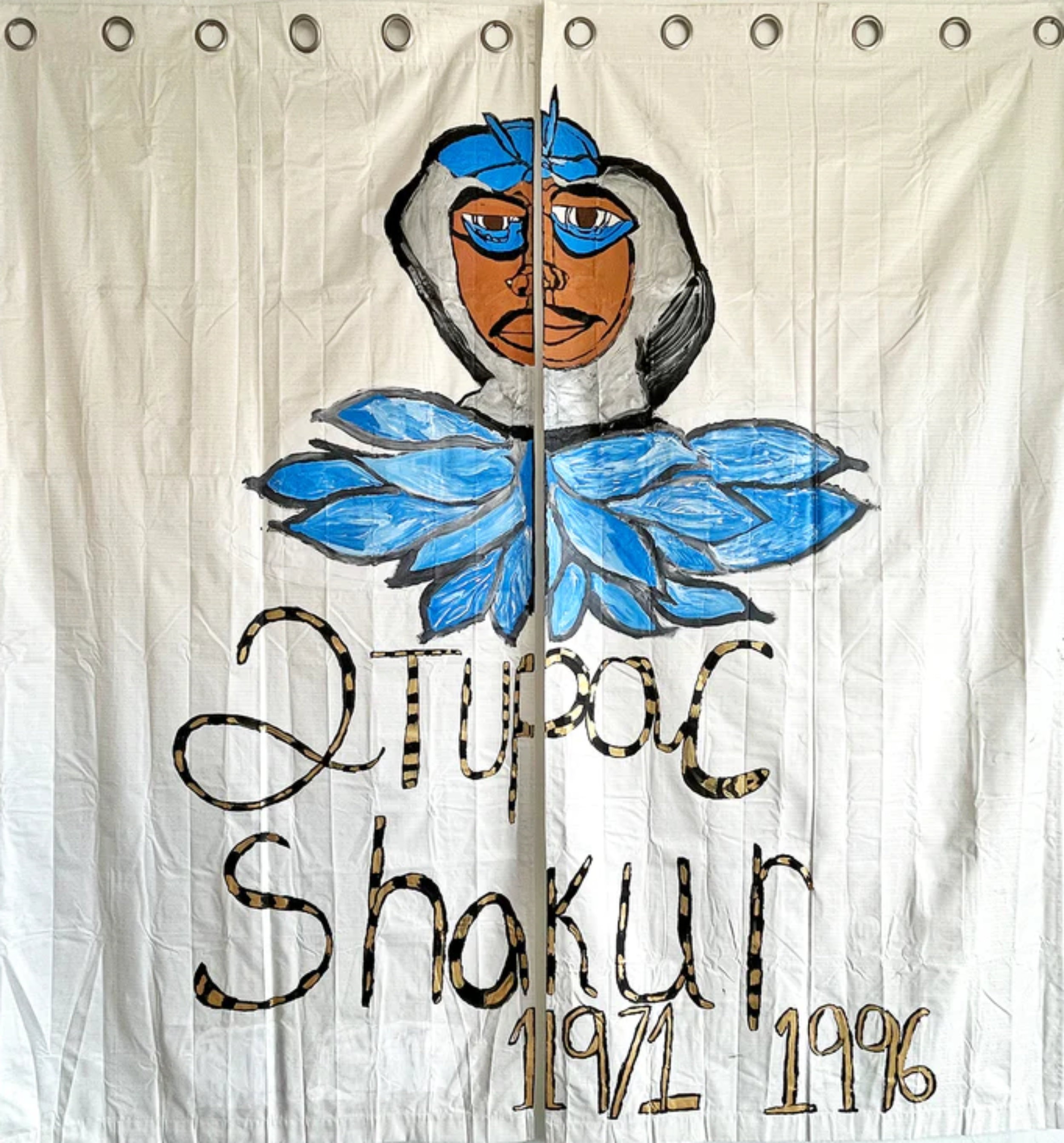
Raven Harper, Portrait of Tupac Shakur, acrylic on polyester curtain, 80 x 84 in, 2022
You can see how people like Julio and Miguel are the heart and soul of NIAD, without them missions are just words and communities miss out on important perspectives, ideas, and beliefs. Reflecting back on Miguel’s approach, listening and observing leads us to dig a little deeper into who we are and what matters to us.
Personally, Miguel reminds me to look at what is in front of me before pushing through the chaos of mothering, the imbalance of work, and the complexity of relationships. Miguel’s message is loud and clear. NIAD got it right in the 80s, and for all those listening and wanting to carry the baton into their own communities, let's keep going together. The first step is boldly asserting that art created by all people holds value. So, step aside Banksy’s of the world, we love you - but Miguel Chacon is in town and he’s listening. He may even be helping us pay attention to those things in life we take for granted.
All images courtesy NIAD Art Center
Find out more about NIAD Art Center: HERE
Monica Fernandez Zuñiga is an independent arts administrator providing management services for artists, arts organizations, and creative entrepreneurs. Find her @artsplotter // artsplotter.com